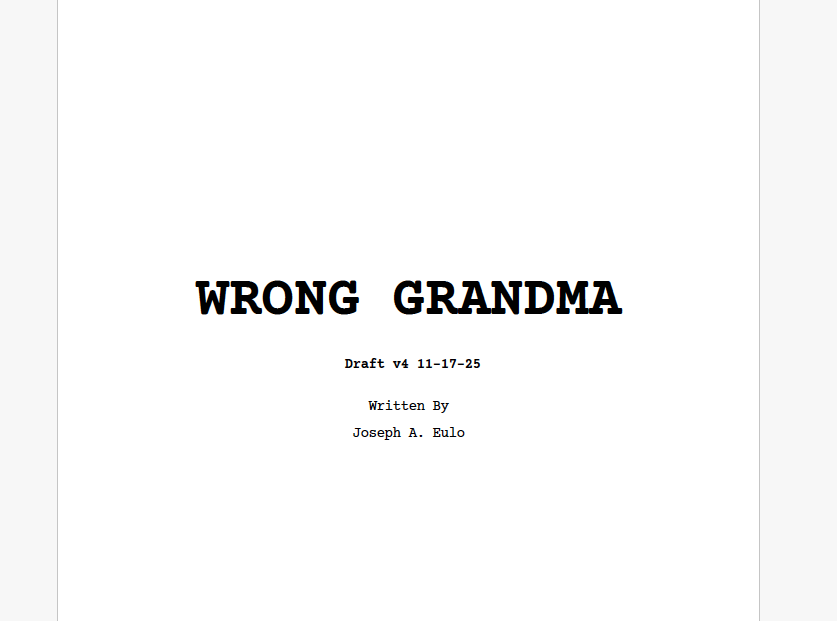
Four Surprising Lessons on Reclaiming Your Power from a Screenplay About a Scammed Grandma
Click here to read the script.
In a world of constant digital noise, the fear of being deceived—of being made to feel foolish or powerless—is a deeply universal one. We look for answers in expert guides and self-help manifestos, but often, the most resonant human truths are found not in instructions, but in stories. This article makes the case for narrative fiction as a unique tool for understanding ourselves, using a short screenplay titled The Wrong Grandma as a powerful case study.
The script tells the story of Susan, an elderly woman financially and emotionally devastated by a phone scammer. But instead of ending with her as a victim, the narrative follows her as she, with her granddaughter Emma beside her, confronts the man who wronged her. In its quiet, tense unfolding, this story offers a masterclass in resilience, providing several profound and counter-intuitive takeaways about fighting back, healing, and reclaiming one’s own dignity.
1. Shame Loses Its Power When It’s Spoken
The screenplay’s treatment identifies a core theme that resonates throughout the narrative: “Shame thrives in secrecy.” Before Susan can even think about confronting her predator, she must first confront her own silence. Devastated by the scam, she hides the loss from her family, paralyzed by a fear they would see her “the way I looked at myself”—as a failure. What the script does so brilliantly here is frame this confession as the story’s true emotional inciting incident. The external plot is secondary to the internal one.
This secrecy forces Susan into a private hell, a world leached of security and even simple joy. The script captures the depth of this private suffering in one devastating line:
“I picked up tomatoes… and put them back. Because I couldn’t afford color anymore.”
Her confession to Emma isn’t just a plot point; it’s the story’s bravest act. By giving voice to her shame, she doesn’t find judgment; she finds an ally. This narrative choice reframes the entire story not as a simple revenge plot, but as a journey of internal healing where the external confrontation is merely a consequence of this first, courageous step. It teaches us that vulnerability isn’t a weakness to be hidden, but the necessary starting point for reclaiming power.
2. Connection is the Predator’s Kryptonite
Predators rely on isolation; connection is their kryptonite. The scammer’s strategy is built on the assumption that Susan is an “Easy mark” precisely because he sees her as an archetype of loneliness: a “sweet little old Grandma with a landline.” He is a disembodied voice, a digital ghost preying on the digitally isolated.
The narrative masterfully demonstrates how physical, present connection shatters this model. When Susan’s hands tremble as she dials, Emma’s simple act of placing her hand over her grandmother’s becomes a symbolic transfer of strength—a grounding, tangible force against the manipulative voice on the line. The scammer’s professional confidence first begins to fray at the exact moment he realizes his victim is no longer a solitary node on his network. When Emma announces her presence—”It means you’re not talking to her alone anymore… asshole”—the script notes that “This lands. Hard.” and “The scammer’s breathing tightens.” The story argues that the ultimate defense against those who prey on the vulnerable isn’t a better firewall, but the steadfast presence of another human being.
3. True Power is Quiet, Not Loud
This scene subverts our expectations of a typical revenge narrative by championing a power that is quiet, not loud. The climax is cathartic not through violence, but through a dignified reclamation of self. This is illustrated in the brilliant contrast between Emma’s righteous fury and Susan’s final, strategic move. Emma is ready for war, her protective anger flaring with a specificity that is both fierce and funny:
“I’ve taken down minivans doing forty. You wouldn’t last two seconds in a crosswalk, dick head!!”
But Susan’s power comes from fundamentally changing the terms of engagement. The scammer expects rage or pleading—emotions he knows how to manipulate. He is utterly unprepared for quiet, factual competence, a language he doesn’t speak. Her victory isn’t about screaming; it’s about a calm, steady assertion of control. Her delivery is described as “deadly soft” as she lands the strategic masterstroke that seals his fate:
“They’re tracing this call.”
This moment is so resonant because it’s not about matching an abuser’s chaotic energy. It is the sound of a woman calmly taking back the narrative, not by shouting over him, but by asserting an undeniable truth that undoes him completely.
4. Recovery Isn’t a Single Victory, It’s a Process
Perhaps the most hopeful lesson the story offers is its realistic vision of what comes after. After the catharsis of the scammer’s arrest, the credits don’t roll on a magically solved life. Instead, the camera stays on the kitchen table, where a stack of “unopened mail” still sits—a powerful objective correlative for Susan’s remaining trauma and the practical work that lies ahead.
The story doesn’t offer a fairytale ending; it offers a beginning. The final exchange between Susan and Emma perfectly illustrates the theme that “Recovery isn’t one grand gesture, but thousands of tiny, brave ones.” Emma’s promise, “Then we take it back. One letter at a time,” is met with a crucial addition from Susan, a line that connects the practical action with the psychological healing: “One truth at a time.” This pairing is the thematic core of the ending. Rebuilding a life isn’t just about paying bills; it’s about facing the truths associated with them. The narrative insists that true recovery is a sustained process of showing up for yourself, one small, brave action at a time.
Conclusion: Taking Back Your Own Story
In an age of loud, performative outrage, The Wrong Grandma champions the forgotten power of quiet dignity, interpersonal connection, and the step-by-step process of healing. It serves as a masterclass in resilience, not by showing us a superhero, but by revealing the profound strength required to refuse to stay silent and alone. The story leaves us with a blueprint for taking back control, one piece at a time.
It begs us to consider: What’s the first “unopened letter” in your own life that you’re ready to face?
Leave a Reply